
For expecting parents
Newborn Prep
The pediatric side of getting ready: a safe sleep space, the short list of things you actually need, how newborn feeding really works, and choosing a pediatrician before baby arrives.
Personalized
Build your own checklist
Tell us your due date, where baby will sleep, and how you plan to feed — we'll turn the guidance below into a checklist with timing that fits your home.
Build my checklistFree feeding, diaper and sleep tracker spreadsheetSafe sleep setup
Get the sleep space right before baby arrives — it's the single highest-impact thing you can prepare.
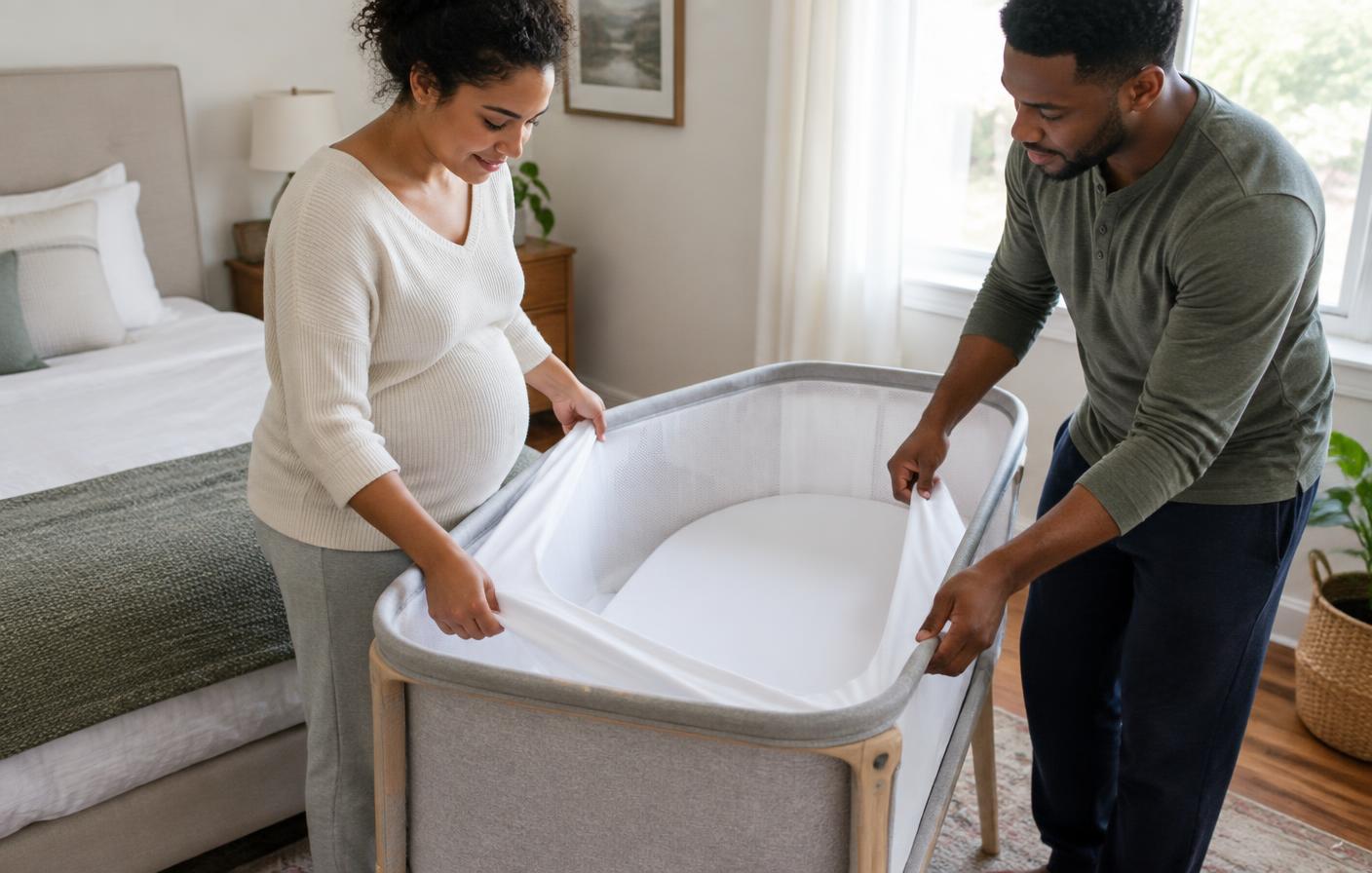
Safe sleep is simple, and it's easiest to get right before you're sleep-deprived. Your baby needs their own flat, firm sleep surface — a crib, bassinet, or play yard that meets current safety standards — placed in your bedroom for at least the first six months.
The mattress should be firm and fit snugly, with a single fitted sheet and nothing else. No pillows, quilts, bumpers, wedges, positioners, or stuffed animals. Babies sleep on their back for every sleep until their first birthday, including naps.
Set the room to a comfortable temperature — if you're comfortable in light clothing, so is baby. Use a wearable blanket or sleep sack instead of loose bedding, and skip hats indoors.
Crib, bassinet, or play yard
Current safety standards; firm, flat mattress that fits snugly.
2–3 fitted sheets
Sized for your exact mattress — no gaps at the edges.
2–3 sleep sacks or wearable blankets
Replaces every loose blanket in the first year.
Room thermometer (optional)
Helps you avoid overheating, a known risk factor.
- Back to sleep, every sleep, for the first year.
- Room-share, don't bed-share, for at least six months.
- Nothing in the sleep space but a fitted sheet and your baby.
- Never let baby sleep unsupervised in a swing, car seat, or nursing pillow.
What to buy — and what to skip
A short list covers almost everything. Most of the baby aisle is optional.
New parents are sold a great deal they don't need. What a newborn actually requires is a safe place to sleep, a safe way to travel, a way to be fed, clothing, diapers, and a car seat that's installed correctly before you leave for the hospital.
Buy the essentials now and wait on the rest. Your baby's feeding method, temperament, and size will tell you what else you need within the first month — and gift registries fill faster than expected.
Rear-facing infant car seat
Install and have it checked before your due date. Never buy used or expired.
Diapers and wipes
One pack of newborn size only — many babies outgrow it in weeks.
6–8 bodysuits and sleepers
Newborn and 0–3 month sizes. Zippers beat buttons at 3am.
Feeding supplies
Bottles and formula, or pump and storage bags — see feeding basics below.
Digital rectal thermometer
The only accurate type for a newborn fever, which is always urgent.
Diaper cream, baby nail clippers, mild soap
Fragrance-free; newborn skin needs very little.
- Skip for now: crib bumpers, sleep positioners, shoes, bulky bedding sets, wipe warmers.
- Wait and see: baby carrier, swing, bouncer, bottle sterilizer, white noise machine.
- Never secondhand: car seats, crib mattresses of unknown history, drop-side cribs.
Feeding basics before baby arrives
Learn how newborn feeding actually works so the first week feels less alarming.
Newborns feed often — typically 8 to 12 times in 24 hours, every two to three hours, including overnight. That frequency is normal and necessary, not a sign that something is wrong or that your supply is low.
Whether you breastfeed, formula feed, or combine both, a fed baby who is gaining weight is the goal. Breastfeeding is recommended where possible, and formula is a safe, nourishing option. Deciding in advance how you'll get help — a lactation consultant's number, your pediatrician's after-hours line — matters more than deciding the method.
Expect your baby to lose a little weight in the first days and regain it by about two weeks. Diaper output is your best day-to-day signal: by day five, look for six or more wet diapers and several stools daily.
Know your feeding cues
Rooting, hand-to-mouth, and stirring come before crying — feed at the early cues.
Line up lactation support
Save a consultant's number now; the first 72 hours are when questions peak.
Read formula prep instructions
If using formula, learn exact mixing ratios and safe water handling in advance.
Plan for burping and spit-up
Small spit-ups are normal; forceful or projectile vomiting is not.
- Feed on cue, roughly 8–12 times a day in the first weeks.
- Call your pediatrician if baby won't wake to feed, feeds under 8 times a day, or has few wet diapers.
- Don't add water, juice, or cereal to bottles — breast milk or formula only for the first six months.
The first pediatrician visit
Choose a pediatrician before delivery and book the first visit for a few days after you come home.
Most babies are seen within 48 to 72 hours of hospital discharge — sooner if there were feeding difficulties or jaundice. Choose your pediatrician in your third trimester, confirm they take your insurance, and ask how after-hours calls are handled.
At that first visit, your pediatrician weighs and measures your baby, checks for jaundice, reviews feeding and diaper counts, examines the umbilical cord and hips, and reviews newborn screening results. It's also your moment to ask everything — bring a written list, because you will forget.
Many practices offer a prenatal meet-and-greet. It's worth taking: you'll know the office, the staff, and who to call before you're calling with a first fever.
Pick a pediatrician by month 8
Check insurance, office hours, hospital affiliation, and after-hours coverage.
Book the first visit before discharge
Target 48–72 hours after you go home.
Bring your records
Hospital discharge paperwork, birth weight, and newborn screening results.
Write your questions down
Feeding, sleep, crying, skin, and anything that worried you at 3am.
- A rectal temperature of 100.4°F (38°C) or higher in a baby under three months is an emergency — call immediately.
- Ask about vaccine schedule, vitamin D, and when to expect the next visit.
- Trust your instincts and call. Pediatric offices expect new-parent questions.
Once baby arrives
Keep going with stage-by-stage guidance for the first three months.
Reviewed by a pediatrician. Educational content only and not a substitute for individualized medical advice.